Post Graduate Diploma in Management (PGDM) in Business Analytics

Businesses today rely on data to make every major decision.

The PGDM in Business Analytics program at VBS prepares students to become confident data driven professionals who can convert numbers into insights and insights into strategy.

This PGDM in Business Analytics program blends strong business understanding with advanced analytics, machine learning, AI based tools and real world datasets. With 15 months of deep classroom learning followed by a 9 month internship, students graduate with both technical expertise and real industry experience.

Program Highlights

  1. AI Enabled and Future Ready Curriculum
    The program equips students with the skills needed to lead in digital, analytics first organizations through certifications in Generative AI and other industry demanded tools and exposure to latest technologies transforming businesses worldwide.
  2. Master Industry Standard Tools and Technologies
    Students gain hands on experience in Python, SQL, Power BI, Tableau, R programming, Big Data and Hadoop ecosystem, Natural Language Processing, cloud computing and MongoDB. These tools help students analyze complex datasets and build practical business solutions.
  3. Learn Core and Advanced Analytics Concepts
    The curriculum covers predictive analytics, machine learning models, data management and data engineering basics, Agentic AI, business statistics and applied analytics across domains such as marketing, finance, HR and operations. Students develop the ability to use analytics in real business decision making.
  4. 15 9 Learning Structure for Real Industry Exposure
    15 months of intensive learning across analytics technologies and business applications followed by a 9 month internship in analytics teams of corporates, fintech companies, consulting firms and data driven organizations. This structure ensures students graduate with strong technical knowledge as well as hands on industry experience that employers value.
  5. Practical and Experiential Learning
    Students learn using real datasets and practical tools through live datasets and model building, case based learning, business simulations, hands on lab sessions in dedicated analytics labs and projects across marketing analytics, financial analytics and operational analytics. This builds confidence and the ability to solve real business problems.
  6. Comprehensive Analytics Curriculum
    The program includes more than twelve analytics focused subjects that build technical depth, analytical thinking, business problem solving and storytelling with data. Students graduate with a strong analytical and managerial foundation.
  7. International Exposure and Scholarship Opportunity
    Eligible students may receive the International Academic Scholarship which covers travel, accommodation, food and course fees for an international immersion program.

Additional Micro Credits

Component Details
Learning Activities Induction Program (Formal, HOD & Cell Briefing)
Outbound Program
Leadership Series
Industrial Visit
Cell Activity Participated
Cell Activity Conducted
Inter College Participation
Sports/Games
Events Hosted
Article / Blogs Published
Consulting Projects
PBL
Business News Awareness
Sell ON Activity
Seminar and Exhibition attended
Open Electives & Other Components Any 2 Open Electives: 60 Marks, 6 credits each (Minimum of 10 students per Open Elective).

Open Electives include:
Ethical Management, Basic & Advanced Excel, Employability Skills, Design Thinking, Performing Arts, Indian Knowledge System, Environmental Sustainability, Business Law, Business & SDGs, Organisational Psychology, Market Research.

Other Micro Credit Components:
Guest Lectures (Minimum 10)
Domain Workshops (Minimum 3)
Self Guided Learning (30 hours)
Data Visualisation
Python
Certifications
Yuva for Seva
Corporate Governance
Research Paper Published
International Immersion
CSR
Entrepreneurship and Venture Creation

Micro credits are earned through the successful completion of the above activities, workshops, certifications and open electives as prescribed in the program requirements.
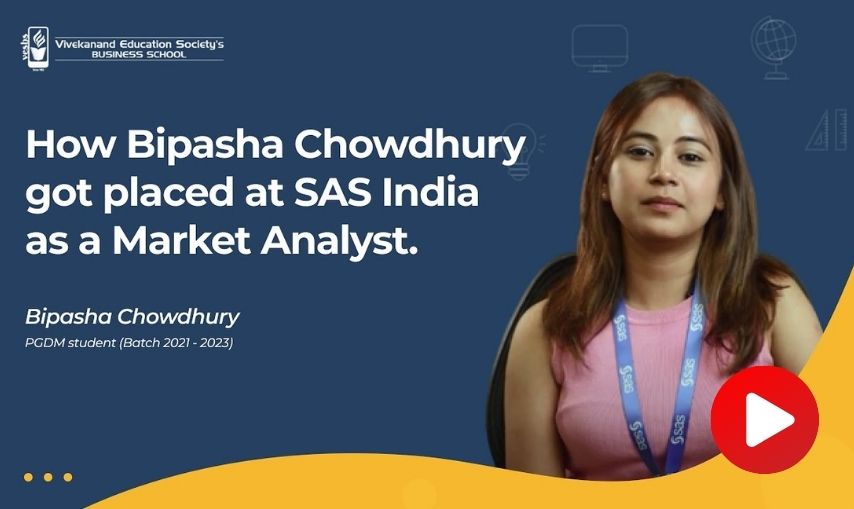
pgdm student from vbs placed in analytics role at SAS India

The PGDM in Business Analytics program at VBS prepares students to become future ready professionals who can use data, AI and analytics to drive meaningful business decisions in a rapidly evolving digital world.

Placement Outcomes

With a blend of strong business understanding, advanced analytics and the 15 9 learning structure, students graduate with both technical expertise and real industry experience that employers value. The comprehensive analytics curriculum builds technical depth, analytical thinking, business problem solving and storytelling with data, preparing students to take up data driven roles across domains in digital and analytics first organizations through a PGDM in Business Analytics.

Course Structure

Program Structure PGDM in Business Analytics Batch 2026-28

1st Year 2nd Year

Module I

Perspective Management
Operations Management
People Management
Financial Accounting
Applied Economics
Marketing Management
Open Elective (opt Any 2)

Module IV

Project Management
International Business
opt any 1 Track

Track B III
B7-Deep Learning
B8-Text Mining and Sentiment Analysis
B9-Mongo DB
B10-Gen AI Tools and Techniques
Open Elective (opt Any 2)

Module II

Selling and Negotiations
Research Methodology
Business Statistics
Financial Management
Opt any 1 Track

Track B I
B1-Advanced Excel
B2-Basic and Advance Python
Open Elective (opt Any 2)

Module V

Industry Immersion / Capstone Project

Module III

Decision Science
Strategic Management
Opt any 1 Track

Track B II
B3-SQL
B4-Big Data with Hadoop
B5-Data Visualization
B6-Predictive Modelling
Open Elective (opt Any 2)

Module VI

Industry Immersion / Capstone Project

Module VII

Industry Immersion / Capstone Project

Note: The syllabus shall be subject to change, if any, by AICTE Directives. Minimum 10 students shall be necessary for starting any specialization.

Frequently Asked Questions

PGDM in Business Analytics is a two-year postgraduate programme that combines management studies with data analysis, machine learning, and business decision-making. It helps students learn tools like Python, SQL, Power BI, and Tableau, along with analytics applications in marketing, finance, HR, and operations.

The programme also focuses on emerging AI platforms and modern data-driven technologies to prepare students for the evolving business landscape. Beyond core academics, students earn industry-recognised certifications and participate in industry lab weeks and expert-led workshops focused on big data ecosystems, cloud analytics, Generative AI, and Large Language Models, ensuring strong practical exposure alongside theoretical learning.

PGDM in Business Analytics can be worth it for students who want to build skills for data-driven business roles. The first 15 months focus on classroom learning in management, analytics, and emerging technologies through courses, hands-on labs, and practical assignments. This is followed by industry exposure that helps students prepare for analytics careers.

The best course for Business Analytics is one that combines business fundamentals, analytical tools, and practical industry exposure. A strong PGDM in Business Analytics should cover Python, SQL, machine learning, predictive analytics, decision science, prescriptive analytics, AI enabled business applications, data visualisation, and real business applications across major functions.

To start a career in data analytics, begin by building skills in statistics, data handling, and business problem-solving. A PGDM in Business Analytics can help you learn Python, SQL, machine learning, and visualisation tools, while internships and hands-on training improve your readiness for analytics roles.

A PGDM in business analytics course helps students build analytical thinking, technical skills, and business understanding. It covers tools like Python, SQL, Power BI, and Tableau, along with machine learning and predictive analytics. It also supports practical learning through labs, workshops, live datasets, and industry exposure.

Vivekanand Business School

Back to Top