5914Views 0Comments
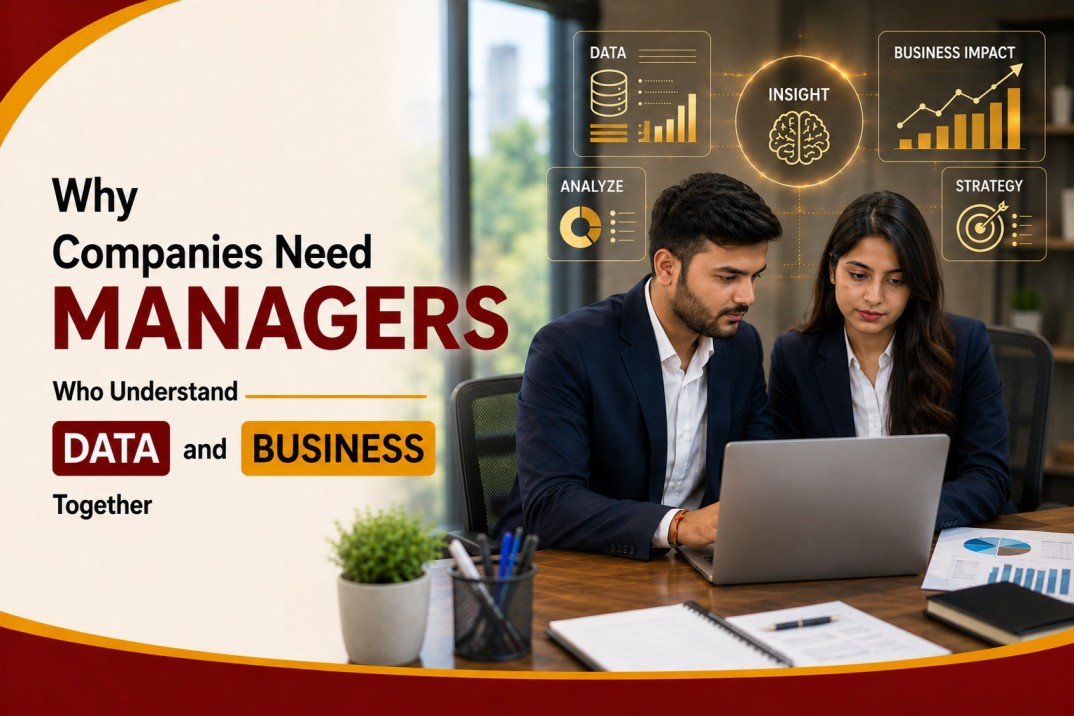
Why Companies Need Managers Who Understand Data and Business Together
Key Takeaways
- Managers now need data skills to make better business decisions.
- Business analytics helps managers understand customers, costs, teams and growth.
- Data driven decision making turns reports into clear action.
- VBS PGDM in Business Analytics blends management learning, analytics tools and a 9 month internship.
Companies need managers who understand data and business because modern decisions depend on evidence, speed and context. A data-fluent manager links numbers with revenue, customers, operations and people. This skill improves planning, reduces bias and turns reports into action. Business analytics for managers helps leaders judge risks, explain insights and guide teams through practical, measurable choices in changing markets today.
What does business analytics for managers mean?
Business analytics for managers means you use data to understand business problems. It does not mean you become a full-time coder. It means you read dashboards, ask sharper questions and explain insights in simple business language.
A sales chart tells you what changed. A manager studies the reason behind that change. Revenue, cost, customer behaviour and team performance all need the same balanced view.
Why are analytical skills no longer optional for managers?
Why analytical skills are essential for managers is clear in daily work. Most teams work with targets, budgets and dashboards. A manager without analytical skill struggles to judge what needs attention first.
Marketing teams study conversion quality. Finance teams study cash flow and risk. Operations teams study delays and resource use. HR teams study hiring patterns and attrition. Leaders study growth signals and market movement.
The World Economic Forum’s Future of Jobs Report 2025 states that analytical thinking remains the top core skill for employers. Seven out of ten companies consider it essential. AI and big data also rank among the fastest-growing skills.
McKinsey reports that intensive users of customer analytics are 23 times more likely to outperform competitors in customer acquisition. They are nine times more likely to outperform in customer loyalty and almost 19 times more likely to achieve above-average profitability.
Old vs New Management
| Old management habit | Data-informed management habit |
| Decisions depend on instinct | Decisions use evidence and judgment |
| Reports are reviewed late | Trends are checked early |
| Teams debate opinions | Teams discuss measured signals |
| Tools sit with analysts only | Managers also understand the insight |
This shift does not remove human judgment. It makes judgment stronger. Data identifies the variables of change and management context finds the root cause.
How does data driven decision making improve leadership?
Data driven decision making gives managers a clearer base for action. A campaign with high clicks and weak sales needs a quality check. A low-cost vendor with repeated delays needs a risk review. A high-performing branch with rising costs needs a margin review.
A good manager does not look at data as numbers alone. The manager checks what the numbers say and why they changed. Then the manager connects the insight with the business problem and helps the team choose the right action.
What will you learn in a PGDM program?
PGDM means Post Graduate Diploma in Management. A strong PGDM in data analytics or PGDM in Business Analytics should teach tools, business logic and decision skills together.
Vivekanand Business School (VBS) offers a PGDM in Business Analytics that blends business understanding with analytics, machine learning, AI based tools and real-world datasets. The program includes 15 months of classroom learning and a 9 month internship. The program builds analytical thinking, technical expertise and business decision-making skills.
Which tools support data analytics for managers?
Tools help managers collect, read and present data clearly. They become useful when managers use them to answer real business questions such as why sales dropped, which customers respond better and where costs are increasing.
VBS offers tools and concepts such as Python, SQL, Power BI, Tableau, R programming, Big Data, Natural Language Processing, cloud computing and MongoDB. SQL means Structured Query Language. NLP means Natural Language Processing. Power BI and Tableau support data visualization and communication.
The VBS curriculum also covers predictive analytics, machine learning, business statistics and applied analytics across marketing, finance, HR and operations.
How does VBS connect analytics learning with industry exposure?
VBS follows a 15:9 learning structure for its PGDM in Business Analytics. Students study analytics technologies and business applications for 15 months. They then spend 9 months in an internship with analytics teams in corporates, fintech companies, consulting firms and data-led organizations.
Students work on live datasets, model building, case studies, business simulations and lab sessions. This helps them apply analytics concepts to real business problems and understand how data supports decisions in different management roles.
Also Read : What to expect after a PGDM in Business Analytics
What makes the VBS program credible?
VBS PGDM program is approved by the All India Council for Technical Education (AICTE). It is accredited by the National Board of Accreditation (NBA) and recognized by the Association of Indian Universities (AIU). The AIU recognition supports academic credibility for PhD and employment goals.
VBS also has 25+ years of legacy, 350+ corporate partnerships and a 93% placement record.
3 steps to start your analytics journey
- Start with the business problem. A clear question helps you understand what the data should explain.
- Learn basic tools step by step. Excel, SQL basics and data visualization help you read data better.
- Explain the insight in simple words. A good manager turns numbers into clear action for the team.
Conclusion
Companies need leaders who understand data because every business decision now has measurable results. Data driven management helps you see what is working, find what needs improvement and guide your team with clear evidence instead of assumptions.
Vivekanand Business School’s PGDM in Business Analytics gives you business learning, analytics tools, AI exposure and internship experience in one well-structured program. Explore the VBS PGDM in Business Analytics and take a step toward evidence-based leadership.
About the Author:
Ms. Hetaal Palan is a result oriented Senior Educational Marketing Professional with over 15 years of rich experience in managing Business Development, Sales & Marketing, Brand Promotion / Launch, Key Account Management & Team Management specialist in the higher education sector. Presently associated with Vivekanand Business School (VBS), Mumbai, as Assistant Director – Branding, Marketing & Student Relations. Follow her on Linkedin.
Frequently Asked Questions
Business analytics for managers is the use of data to understand business problems and make better decisions. It helps managers read reports, track performance, study trends and connect data with goals like revenue, cost, customers and operations.
Managers need data analytics skills to make informed decisions based on facts, not only assumptions. These skills help them understand performance, identify risks, measure results and guide teams with clearer business insights.
Coding is not always required at an advanced level for a PGDM in Business Analytics. Students usually learn basic analytics tools, data handling and business-focused interpretation, while the main focus stays on using data for decision making.
Data driven decision making helps business growth by improving planning, reducing guesswork and showing what is working. It helps managers track customer behaviour, control costs, improve processes and choose actions based on measurable results.
Career roles after a PGDM in Business Analytics include business analyst, data analyst, marketing analyst, financial analyst, operations analyst and analytics consultant. These roles focus on using data to solve business problems and support better decisions.