
6040Views 0Comments
Career Options After PGDM: Higher Studies, Global Careers & Entrepreneurship Explained
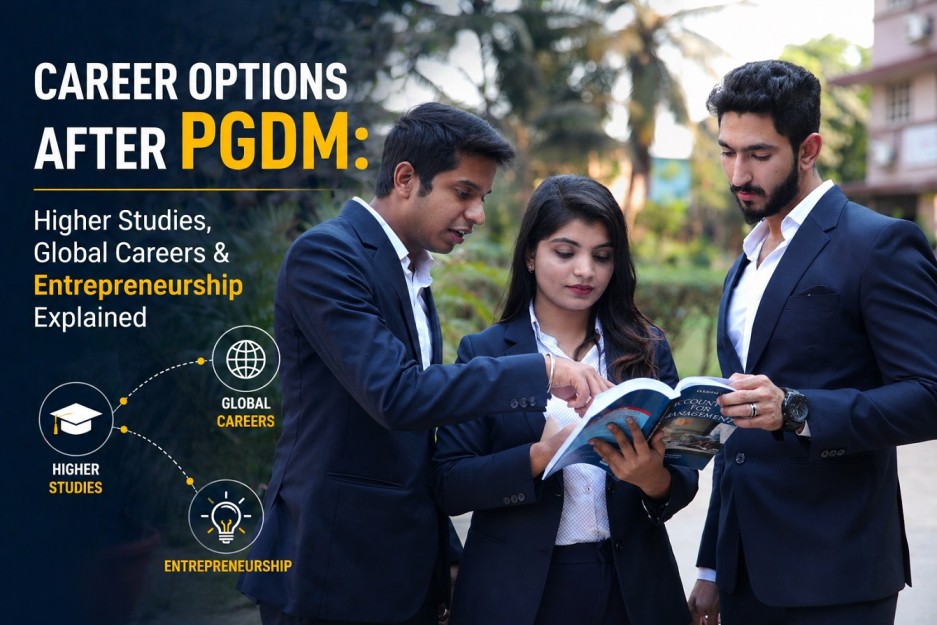
Key Takeaways
- Career options after PGDM are no longer limited to traditional corporate roles.
- Higher studies, global careers, and entrepreneurship are the three major pathways.
- Career growth depends more on skills, adaptability, and exposure than just the degree.
- Global career opportunities are now accessible without mandatory relocation.
- Entrepreneurship after PGDM is a structured and viable career option.
- A strong professional profile is built through experience, skills, exposure, and network.
Introduction
If your first instinct after reading a title like this is to ask, “What are the career options after PGDM?”, you may already be looking at it too narrowly. The more relevant question today is: What kind of career do you want to build, and how quickly do you want to get there?
Recent reporting and market insights highlighted by The Times of India (2025–2026 career trend coverage) show a clear shift in post-PGDM career preferences. A growing share of management graduates are no longer chasing only traditional corporate roles; instead, they are prioritizing faster career acceleration, global exposure, and roles in high-growth domains like analytics, consulting, and product management.
Compensation growth is increasingly tied to skill depth and adaptability rather than just the degree itself, reinforcing the idea that outcomes are no longer linear. Your PGDM is not merely a stepping stone into corporate or managerial roles, nor is it just a placement pipeline.
In reality, it operates more like a multi-variable system, one where the input is defined by your skills, exposure, and ambition; the process is shaped by continuous learning, experimentation, and iteration; and the output is a career that compounds over time.
At institutions like Vivekanand Business School (VBS), this system is intentionally designed not just to secure placements, but to position our students for long-term growth in an evolving job market. From this foundation, three distinct yet interconnected pathways naturally emerge: higher studies, global careers, and entrepreneurship.
These are not rigid choices, but dynamic outcomes, largely determined by how effectively you engage with and leverage the system.
Higher Studies After PGDM: Depth Over Speed
Can I Do a PhD After PGDM?
Yes, you can pursue a PhD after a PGDM if the PGDM program is recognised as equivalent to an MBA by AIU (Association of Indian Universities). This academic equivalence is important because many universities consider it during PhD admissions. But eligibility is only one part of the answer.
The more important question is whether you are inclined to ask better questions than most people, because a PhD is not really about finding answers. It is about developing structured curiosity and the discipline to explore complex ideas deeply over time.
The Academic Pathway: A Layered Model
Think of higher studies after PGDM as a three-layer progression:
Layer 1: Conceptual Foundation
Built during PGDM through:
- Case-based learning
- Analytical frameworks
- Exposure to ambiguity
Layer 2: Specialization
Through:
- Doctoral programs
- Research fellowships
- Domain-focused study
Layer 3: Thought Leadership
Where you:
- Publish research
- Influence business thinking
- Shape future professionals
Executive Education: The Compounding Effect
Not everyone chooses the long route of a PhD. Some optimize for speed + relevance.
Executive programs allow professionals to upgrade without pausing their careers, align with evolving industries, and stay ahead of obsolescence.
In a volatile job market, learning is no longer linear. It is modular, continuous, and strategic.
Global Careers After PGDM: Geography Is No Longer a Constraint
The New Definition of “Global”
Earlier, global careers were defined by relocation; today, they are defined by integration. You could be sitting in Mumbai, collaborating with a European client, reporting to a US-based manager, and contributing to projects that span multiple time zones, all without physically moving countries.
The shift has been driven by digital transformation, distributed teams, and companies building borderless talent ecosystems. For PGDM graduates, this means global exposure is no longer a distant goal but an immediate reality.
Cross-cultural communication, adaptability, and the ability to work in diverse, virtual environments matter as much as technical and managerial skills.
A PGDM at Vivekanand Business School (VBS) is designed around outcomes, not just academics. With in-demand specializations like Business Analytics, Supply Chain & Operations, Marketing, and Finance, our curriculum focuses on practical skills, industry tools, and real-world exposure.
Backed by experienced faculty, a strong alumni network, and international immersion opportunities, we prepare our students not just for placements, but for long-term, future-ready global careers opportunities.
How PGDM Enables International Mobility
The pathway is not random. It follows a pattern:
- Skill acquisition
- Exposure to global frameworks
- Application in cross-border roles
The Skill Equation for Global Roles
Global careers are not unlocked by degrees alone. They require a specific combination of cultural intelligence, analytical clarity, and communication precision.
Cultural intelligence helps you understand people beyond borders, analytical clarity helps you make decisions with incomplete data, and communication precision ensures you say more with less.
At VBS, these are not taught in isolation. They are developed through projects, internships, and real-world interaction.
International Exposure: Signal vs Noise
Many programs offer international exposure, but few make it meaningful. The difference lies in intent.
Is it tourism? Or is it contextual learning?
At VBS, our global immersion is structured to expose students to real business ecosystems, build adaptability, and reduce the “unknown” factor in global careers.
Because confidence is not built by theory. It is built by context.
Entrepreneurship After PGDM: From Employability to Ownership
From an entrepreneurship perspective, a PGDM marks a clear shift in mindset. A job is a function of opportunity, but a business is a function of ownership, risk, and long-term vision.
Choosing entrepreneurship after a PGDM means stepping into ambiguity with intent. It’s not just about launching a startup; it’s about learning how to think in systems, evaluate risk with clarity, and allocate limited resources under uncertainty.
This structured approach to decision-making is what separates ideas from scalable ventures. Over the past decade, several Indian founders with management education backgrounds have translated this mindset into billion-dollar outcomes.
Entrepreneurs like Deepinder Goyal (Zomato) and Falguni Nayar (Nykaa) have built unicorns by combining strategic thinking with disciplined execution.
Their journeys highlight how formal management training can strengthen decision-making, market understanding, and scaling capabilities. What ties these stories together is not just innovation, but the ability to apply structured thinking, adaptability, and execution under uncertainty.
In today’s landscape, entrepreneurship after PGDM is no longer an alternative path. It is a high-potential, high-impact career choice for those willing to build rather than follow.
The Startup Equation
Every startup begins with three variables:
- Problem
- Market
- Execution
PGDM programs train students to evaluate all three, not emotionally, but analytically.
Incubation & Mentorship: Where Ideas Become Structured
Most startups don’t fail because of bad ideas; they fail due to gaps in execution. The real challenges are lack of guidance, poor execution discipline, and limited access to the right resources at the right time.
Even strong concepts can struggle without a structured environment to test, refine, and scale effectively. This is where incubation plays a crucial role.
An incubation ecosystem provides a controlled space for experimentation, helping founders validate ideas before taking them to market. It offers infrastructure, strategic direction, and access to networks.
Mentorship further amplifies this process. It acts as a time accelerator, helping you learn faster with the right guidance.
At Vivekanand Business School (VBS), students have access to mentors including industry professionals, founders, and academic experts. This creates a continuous feedback loop—idea, feedback, refinement, and execution.
Building a Global Professional Profile: The Compounding Advantage
Degrees Open Doors. Profiles Keep Them Open.
A PGDM opens the door, but your skills, mindset, and profile ultimately determine the direction and speed of your career trajectory.
The Four Pillars of a Strong Profile
1. Experience
Internships and projects → Proof of application
2. Skills
Certifications and tools → Proof of capability
3. Exposure
Global programs and industry interaction → Proof of adaptability
4. Network
Alumni and professional connections → Proof of relevance
Why This Matters
Recruiters are not just hiring for roles; they are hiring for potential under uncertainty.
A strong profile signals that you can learn, adapt, and deliver in dynamic environments.
Alumni Journeys: Patterns, Not Just Stories
Structured Growth
The first pattern is structured growth. It typically begins with an entry-level role, followed by consistent skill accumulation and learning.
Within three to five years, this often leads to a strategic transition into higher-responsibility roles or specialized domains.
Global Transition
The second pattern is global transition. Many careers start with a domestic role and gradually expand into cross-border exposure.
Over time, this evolves into roles with direct international responsibility and global scope.
Entrepreneurial Leap
The third pattern is the entrepreneurial leap. This path usually starts with industry experience, where individuals identify real market gaps.
This insight then translates into venture creation, backed by practical knowledge and calculated risk-taking.
These are not exceptions; they are repeatable trajectories. When the PGDM ecosystem is leveraged effectively, these patterns become predictable pathways.
PGDM as a Strategic Asset
The question is not whether a PGDM leads to opportunities—it does. The more important question is: which opportunity are you optimizing for?
Some choose depth, leading to higher studies and research-oriented paths. Others pursue scale, building global careers across markets and functions.
And some choose ownership, stepping into entrepreneurship to create and lead ventures.
A well-structured program like Vivekanand Business School (VBS) does not force you into a single direction. Instead, it builds your capability to move across these pathways with confidence.
Through an industry-aligned curriculum, strong mentorship, global exposure, and practical learning, VBS positions students to not just access opportunities, but to shape them strategically.Because in the end, a PGDM is not about the first job you secure. It is about the next 10 years of your career and how effectively they compound.
About the Author :
Ms. Hetaal Palan is a result oriented Senior Educational Marketing Professional with over 15 years of rich experience in managing Business Development, Sales & Marketing, Brand Promotion / Launch, Key Account Management & Team Management specialist in the higher education sector. Presently associated with Vivekanand Business School (VBS), Mumbai, as Assistant Director – Branding, Marketing & Student Relations. Follow her on Linkedin.
Frequently Asked Questions
Career options include corporate leadership, global roles, entrepreneurship, and higher studies. The path you choose depends on your specific skills, long-term goals, and professional growth plans.
Yes, provided your PGDM is recognized as MBA-equivalent by the AIU. This path is perfect for those looking to build deep expertise in research and academics.
Absolutely. It prepares you for cross-border business environments, equipping you with the skills to manage international teams and navigate diverse global markets.
PGDM develops essential business, financial, and strategic thinking. Many programs also provide access to mentorship and incubation support to help turn your ideas into successful ventures.
This specialization focuses on managing international supply chains and operations, preparing you to handle complex business functions within the global marketplace.