
7533Views 0Comments
Vivekanand Business School: Reimagining Management Education Through European Pedagogy
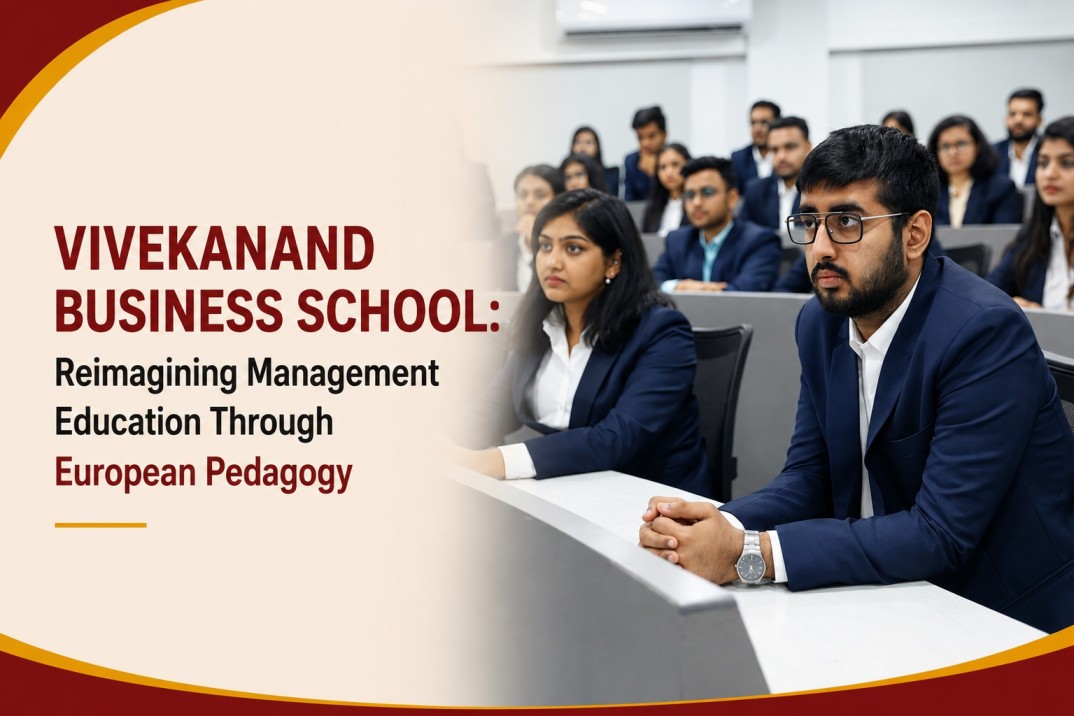
Business education is changing fast. The traditional pedagogy of classroom lectures, textbook learning and end-of-semester exams is slowly being replaced by more interactive, experiential and globally connected ways of learning. Top business schools in Europe have been leading the evolution of management education towards critical thinking, experiential learning, leadership development and responsible business. Schools such as INSEAD, London Business School, HEC Paris, IESE Business School, IMD, ESADE, ESCP Business School and University of St. Gallen have become known all over the world. And not only because of their rank, but also because of their innovative teaching methods.
Inspired by the above global best practices, Vivekanand Business School (VBS), Mumbai, India, has adopted a learner centric pedagogy which aims to integrate academic rigor with industry relevance. The Vivekanand business school philosophy is to reflect many of the tenets practiced by prominent European institutions with a focus on experiential learning, case-based teaching, project-based learning, industry engagement, research and international exposure. Vivekanand business school believes that management education is not just a transfer of theoretical knowledge but to create PGDM students who are able to think critically, solve complex business problems, work together and lead with responsibility.
The core idea of Vivekanand business school is that management cannot be learnt only by attending lectures. Instead, future managers will develop their abilities through the analysis of complex business situations, the solution of real organizational problems, work with multidisciplinary teams and reflection on their learning experiences. Faculty members are facilitators of inquiry, debate, and evidence-based decision making, turning classrooms into vibrant learning environments. Our faculty members have a wealth of experience and blend strong academic credentials with a deep understanding of industry expectations and the changing face of business management education.
The case study method is one of the most distinguishing features of the pedagogy used at Vivekanand business school. Case discussions give students a feel for real organizational problems and require them to analyse data, weigh options, talk about conflicting points of view, and propose workable remedies. Case studies form an integral part of functional disciplines like marketing, finance, human resource management, operations, and business analytics at Vivekanand Business School. We promote discussions in the classroom where students can defend their point of view with analytical reasoning, improving decision-making and communication skills.
This is complemented by project-based and experiential learning, allowing students to translate classroom concepts into real business situations. Vivekanand business school is dedicated to live industry projects, consulting assignments, internships, field visits and business simulations. Our students partner with organizations to tackle real management issues, gaining hands-on 2
experience in problem diagnosis, data collection and analysis, and delivering practical recommendations. This kind of experience is a great way to improve industry readiness by bridging the gap between theory and practice.
An important aspect of Vivekanand business school pedagogy is industry engagement. Students get to interact with corporate leaders, attend guest lectures and workshops, take part in management conclaves and engage in mentoring sessions, thus gaining valuable insights into current business practices. Industry professionals often teach in the classroom, allowing students to see how to apply a management concept and to build their professional networks.
International exposure is another important pillar of modern management education. Vivekanand business school provides international immersion opportunities where students get exposure to varied business environments, international organizations and cross-cultural management practices. These experiences allow learners to acquire broader global mindsets, better cross-cultural communication skills and prepare them to work in increasingly interconnected business ecosystems. We have had opportunities to send our students to Singapore and Malaysia in the past.
Research is at the heart of what we do at Vivekanand business school. We bring current research findings into classroom discussions, making learning relevant to the present-day business world. Vivekanand business school encourage faculty members to include recent research, industry reports, business analytics and evidence-based management practices in teaching. Students will also be encouraged to pursue research projects, attend conferences, write case studies, and engage in scholarly inquiry with faculty mentors. This method fosters analytical thinking and develops a research attitude that goes beyond the classroom.
Collaborative learning is another key component of the Vivekanand Business School experience. Most courses are built around group projects, presentations, debates, role-plays, business games and collaborative assignments where students work in diverse teams to solve managerial problems. These activities develop skills in teamwork, negotiation, leadership, communication and conflict management, which employers increasingly seek from management graduates. Classroom discussions are the backbone of every course, encouraging students to challenge their own assumptions, consider competing perspectives, and gain confidence in articulating evidence-based opinions.
Leadership development is also built into the program of study. Students also engage in presentations, student-led activities, mentoring sessions, personality development workshops and reflective exercises to develop self-awareness, emotional intelligence and ethical leadership, in addition to technical knowledge. The faculty mentors help students to identify their strengths and prepare them for managerial positions in a business environment that is increasingly dynamic.
The digital transformation has also had an impact on innovation in teaching. Like many leading European institutions, Vivekanand business school uses digital learning platforms, business analytics programs, artificial intelligence applications and technology-enabled teaching methods to improve classroom learning. Students will learn modern digital technologies and develop 3
analytical and problem-solving skills that are key for Industry 4.0 and the emerging AI-driven economy.
Vivekanand business school is dedicated to advancing responsible management education. Sustainability, ethics, corporate governance and Environmental, Social and Governance (ESG) issues are becoming more and more embedded throughout management disciplines in European business schools. Also, Vivekanand business school aims to make students aware of the wider societal impact of management decisions through its courses, community engagement activities, social projects and discussions on ethical leadership and sustainable business practices. This comprehensive strategy helps students understand success in an organization must be balanced with social responsibility and long-term value for stakeholders.
The assessment methods at Vivekanand Business School are also in line with the modern teaching practices. Student performance is assessed through case studies, live project reports, presentations, class participation, research assignments, group projects, simulations and reflective learning activities instead of relying only on traditional written exams. Continuous assessment offers faculty opportunities to assess conceptual understanding and practical competencies and students’ opportunities to obtain regular developmental feedback.
Vivekanand Business School’s pedagogy philosophy is a model of how Indian management institutions can successfully customize internationally accepted best practices to the needs of the local industry. The institution fosters an educational environment of ‘learning through doing’ through case studies, live projects, project-based learning, international immersion, research-driven teaching, collaborative learning, industry interaction and continuous assessment, which mirrors many of the characteristics of the leading European business schools and meets the unique challenges and opportunities of the Indian business landscape. In the face of rapid technological, economic and societal change, employers are increasingly looking for graduates who can think critically, collaborate across cultures, solve difficult issues, lead ethically, and adapt to constant change. With its industry-oriented and learner-centric pedagogy, Vivekanand business school aims at nurturing professionals with not only technical competence but also the agility, innovation and leadership abilities required in today’s global economy.
To summarize, Vivekanand business school has adopted many of these principles by creating an educational ecosystem focusing on experiential learning, case-based discussions, live industry engagement, project-based learning, research, international immersion and collaborative learning. This is consistent with pedagogy practices that are recognized globally and speaks to the institution’s commitment to prepare responsible, innovative and globally competent management professionals who are equipped to make meaningful impact in business and society.
Dr. Ajay Gupta
Professor
Vivekanand Business School